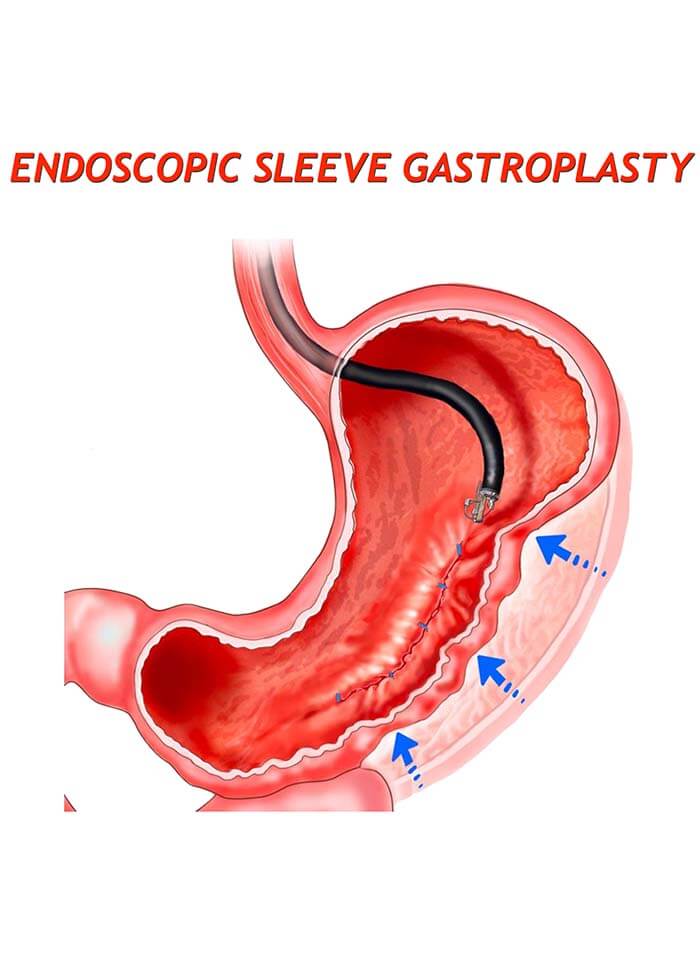
ENDOSCOPIC SLEEVE GASTROPLASTY (ESG)
-
Dr. AMAR VENNAPUSA
– It is a non surgical endoscopic weight loss procedure for individuals suffering from obesity or diabetes especially for those who are afraid of bariatric surgeries.
– It is an endoscopic procedure in which greater curve of stomach is inverted (folded) into the stomach and sutured endoscopically in order to reduce the stomach volume.
– As stomach capacity is reduced, patient can’t take large quantity of food at a time.
– It is indicated for temporary weight loss in those who are unfit for or who doesn’t want bariatric surgery.
– It is indicated for mild obesity.
– It is also a procedure for those who can’t lose weight by lifestyle modifications, at the same time are not eligible for bariatric surgeries.
Procedure:
- An upper gastrointestinal endoscopy is performed,
- Stomach volume is reduced by applying ‘U’ shaped interrupted sutures in the body of stomach using disposable endoscopic instruments and equipment called Apollo Overstitch.
- Upper part of the stomach (Fundus) and lower part of the stomach (Pyrloric antrum) are not sutured.
- Stomach body becomes like a tube.
As per IFSO Guidelines 2022
– In India and Asia,
1. Individuals suffering from mild obesity with the body mass index is ≥ 27.5 kg/m2 with co-morbid medical conditions such as uncontrolled type 2 diabetes.
2. Individuals suffering from severe obesity with the body mass index is ≥ 32.5 kg/m2 even without any co-morbid medical conditions.
– In Western countries
1. Individuals suffering from mild obesity with the body mass index is ≥ 30 kg/m2 with co-morbid medical conditions such as type 2 diabetes.
2. Individuals suffering from severe obesity with the body mass index is ≥ 35 kg/m2 even without any co-morbid medical conditions.
– ESG is mainly a restrictive procedure.
– It acts mainly by limiting calorie intake. Individuals feel full even after taking small quantity of food.
– But it also causes some physiological changes which reset fat mass to a lower level.
– IGB combined with lifestyle modifications can result in 15 to 20% of the total body weight loss.
– To improve the outcomes Oral Semaglutide can be added.
– On average patients lose 15 to 20 kg of the weight.
– There are people who lost more than 30 kg weight also. But that will be 1 or 2 out of 100. Based on those 1 or 2, we can’t claim that everyone loses weight similarly.
– And some people may not lose weight at all after endoscopic sleeve gastroplasty.
– And some more will gain weight even in the presence of balloon.
– It is simple, very safe and doesn’t require admission.
– Can be done as a day care procedure.
– Patients will be in a position to leave hospital 12 hrs after the procedure.
– There is no foreign body as in intra gastric balloon.
– It doesn’t require any cuts on the abdomen (No scars on the tummy).
– It is a good choice for weight loss in individuals with BMI < 30 kg/m2. It is considered as an adjuvant to healthy diet, exercise and behavioral modification in these individuals. In these, since weight burden is not much, fat set point can come down to some extent by healthy diet and exercise. And ESG helps to increase weight loss. Once stomach expands, these individuals should stick on to healthy diet and exercise in order to keep fat set point nearer to normal limits.
– Since physiological changes after ESG are not much, weight loss and diabetes remission are inadequate.
– As time goes on stomach expands. Weight regain chances are very high once stomach expands.
– Weight loss after ESG is temporary especially when it is performed in individuals with BMI ≥ 30 kg/m2.
– Those who regain weight after ESG, need bariatric surgery for weight loss.
– It is a simple and very safe procedure.
– Apart from initial abdominal discomfort, nausea and vomitings in some patients, major complications are rare.
– Just like after any bariatric surgery, follow up at regular intervals is needed.
– Initial 2 weeks will be liquid diet, followed by healthy soft diet and then healthy normal diet.